| |
 | Christine Murray
Branch Head, Food and Bio-Industrial Crops
Crop Diversification Centre South
301 Horticultural Station Road East
Brooks, AB, Canada T1R 1E6
For further information about CDCS, contact Shelley Barkley. |
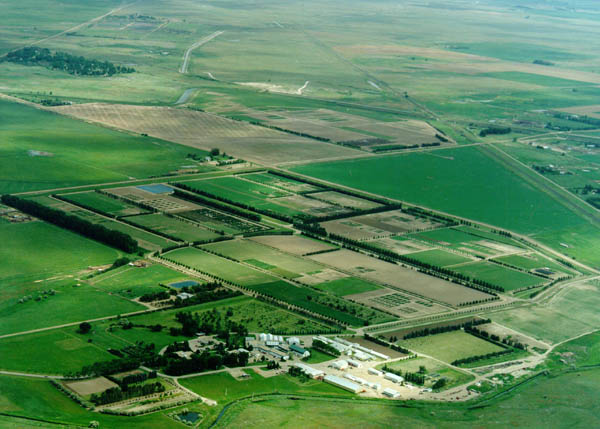
The Centre is located in the semi-arid shortgrass prairie region of southeastern Alberta, where temperatures range from -40 to +39° C. Annual precipitation averages 300 mm, with rainfall averaging 150 mm during the growing season. The combination of irrigation, an average of 2,400 bright sunshine hours together with a long-term average growing season of 137 days, provide excellent conditions for plant growth.
CDCS operates four farms; Lendrum Farm (Head Quarters site), McLeod Farm, Ponderosa Farm and the Bow Island Sub-station. There is 10,500 sq.ft. of laboratory space (including controlled environment storages, growth chambers, tissue culture facilities, seed laboratory, chemistry laboratories, food science laboratories and plant pathology laboratories), and 44,000 sq.ft. of machine shop and general storage for machinery and fertilizers.
In 1935, the Canadian Pacific Railway had losses of $400,000 in the “eastern section”; the Headquarters Farm was turned over to the Provincial Government. Since 1935, CDCS has played a key part in aiding in the establishment and further expansion of horticultural industries in Alberta.
The breeding programs at the Centre in the late 1950’s through the 60’s paid off with the release of Castle sweet pepper, and Brookpack tomato. Many of the fruit varieties with Brook in their name like Fallbrook raspberry and Brookgold plum originated from here. Speaking of plant releases, crosses made between a native female cottonwood collected at Steville in 1918, by Mr. Augustus Griffin, and a male Russian poplar are backbone of many of today’s farm shelterbelts. Six male clones were selected from the cross from these six, Brooks #1 was named “Griffin Poplar”, after Mr. Gus Griffin and Brooks #4 and #6 became part of the shelterbelt program in Alberta.
In 1981 the Centre was instrumental in the establishment of the commercial saskatoon berry industry. An over-the-row blueberry harvester and bush fruit cleaning equipment was adapted to saskatoons. This equipment was lent to producers to start them on their way to success in the saskatoon berry industry. Today there are about 2200 acres of saskatoon berry production in Alberta.
CDCS has been instrumental in educating growers in the “how-tos” of growing. We have long worked along side the greenhouse industry in Alberta trying new production methods. In the fall of 2009, a new state-of-the-art greenhouse will open at CDCS. This facility will have 1 acre of pre production greenhouse as well as 9 separately controlled greenhouse bays that will meet the needs of CDCS researchers.
The fruits of CDCS involvement with the horticulture industry in Alberta

1935 | 
Approximately 32 tons of fruit were picked at the station during the season, 25 tons sold to the Hudson’s Bay in Calgary and Edmonton |

1943 | 
Alberta produces nearly 47,000 pounds of vegetable seed to respond to worldwide seed need. Seed production contracted to farmers, supervised by Centre Staff |

1953 | 
Non-horticultural crops are planted at Centre including hops and field corn |

1954 | 
Provincial Horticulture Station relocates to Lendrum farm. |

1965 | 
Centre builds the first Filacell cooler in Canada for long term storage of produce |

1968 | 
Castle Sweet yellow pepper released from Centre Vegetable Breeding Programs |

1970 | 
Brookpack and Brookpact tomatoes released from Centre Vegetable Breeding Programs |

1979 | 
Sunnybrook, Rosybrook apples, Brookgold and Brookred plums and Brookcot apricot were released from Centre's fruit breeding programs |

1983 | 
Over the row blueberry harvester bought and adapted for harvesting saskatoons |

1986 | 
Day neutral strawberries are introduced into Alberta |

1991 | 
New production greenhouse built, attached to Hargrave Building |

1992 | 
First 4 year old ginseng is harvested |

1998 | 
Precision delivery system for carbon dioxide developed for greenhouse industry |

2002 | 
Fish and plants are being combined in a unique growing closed system called aquaponics |

2008 | 
Dr Ron Howard, Plant Pathologist, wins the Dow AgroSciences/ASTech Innovation in Agricultural Science Award |

2008 | 
Destruction of the 40 year-old greenhouse facilities and construction of the new, state-of the-art, greenhouses begins. Construction end date 2009. |
Walking Tour Guide of Grounds at Centre
CDCS Rose Garden Guide
 |
|