| |
Dutch Elm Disease Sampling Procedures | |
| |
|
|
| |
|
|
| | Back to Dutch Elm Disease Home Page
.
Important points to remember | DED sample submission form
Before taking a sample call STOPDED @ 1-877-837-ELMS (3567).
How to take a good sample
| 1. Only sample an elm tree between June 1 and September 30. |
2. Sterilize your pruning tools with methyl hydrate (gas line antifreeze), 70% alcohol or 10% bleach. The use of bleach can rust the pruning equipment. Wash equipment and spray with WD40.
.
3. Select the branch in the elm tree that is showing the typical DED symptoms of leaf wilt or browning. This may require the use of a pole pruner. |  | 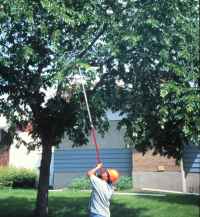 |
4. Check this branch for brown staining in the cambium under the bark, a symptom of DED. If staining is not found, try another branch on which the leaf symptoms appear. While staining is a strong indicator of DED, it is not always present in a diseased tree.
.
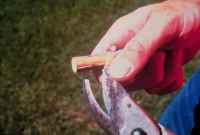
5. Select a portion of the branch measuring 1-2 cm (up to 1 inch) in diameter. Cut 5 or 6 pieces about 15 cm (6 inches) in length, from a part of this branch. The sample branch must be taken out of the section of the tree showing symptoms.
6. Please do not submit:
- pieces from which the bark has been peeled, samples must have bark intact
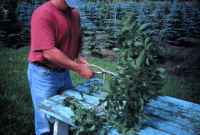
- with elm leaves or twigs, remove these from the cut pieces
- large branches
| | 
 |
| 7. Wrap all branch pieces in wax paper making sure that the wax paper surrounds the entire bundle, secure with tape to prevent drying and maintain proper humidity. (Do not place branches in a sealed plastic bag as it promotes molding).
8. Place bundle in an paper envelope or paper bag.
9. Fill out a "DED Sample Submission Form" with your assigned code number, your name, complete location or street address, phone number and date sampled. Contact STOPDED Hotline for your code number at 1-877-837-ELMS. | | 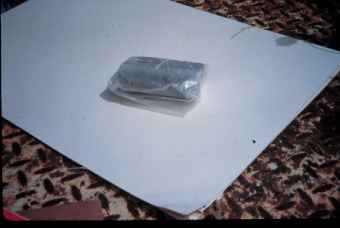 |
| . |
| 10. Include any information about the tree or growing conditions under comments on the submission form that would be helpful in identifying the problem |
| 11. Ensure that the sample includes the same code number as on the submission form. Mark this number on the envelope or bag with a felt marker. |
| 12. Include one copy with the sample which will go to the lab. |
| 13. All samples should be kept in a cool place until reaching the lab to prevent deterioration. |
| 14. Samples can be sent to the lab using any private courier. Send specimens early in the week and avoid late-week submission as specimens may deteriorate in transit. |
| 15. Tag the tree to identify it as being tested. Make sure that the same code number is on the tree, sample and DED Sample Submission Form |
| 16. Disinfect the pruner head, secateurs and knife before taking the next sample. (This will prevent the possible spread from an infected tree to an uninfected tree). |
Important points to remember
Samples that are not sent properly are a waste of laboratory time. Re sampling is the only course of action. Ship samples with proper documentation (submission form).
| Do not send very small twigs that are impossible to peel or culture or dead branches |
| Solution: Refrigerate for the weekend and ship Monday |
| Do not allow samples to accumulate for a week or more before shipping |
| Solution: Ship weekly |
| Do not ship sample branches in a plastic bag |
| Solution: Re sample, wrap in wax paper and place in paper envelope or bag. |
For information about STOPDED or Dutch elm disease contact stopded@shaw.ca at STOPDED Hotline: 1-877-837-ELMS (3567) |
|
| |
|
|
| |
Other Documents in the Series |
|
| |
Do You Have Elms
Firewood Can be DED-ly
Dutch Elm Disease Cycle
Signs and Symptoms of Dutch Elm Disease
Dutch Elm Disease Sampling Procedures - Current Document
Dutch Elm Disease: Signs of Beetle Activity
|
|
| |
|
|
| |
For more information about the content of this document, contact Shelley Barkley.
This information published to the web on June 14, 2001.
Last Reviewed/Revised on February 5, 2019.
|
|