| |
 Economics and Competitiveness Economics and Competitiveness
,
Background
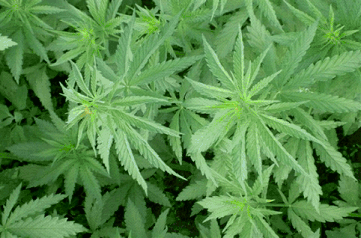 This report provides an update on industrial hemp production area licensed by Health Canada and processing industry development prospects in Alberta and Canada. Industrial hemp (Cannabis sativa) is one of the oldest cultivated plants in the world (Figure 1). It can be grown as a fibre, seed or dual purpose crop. The species was banned in North America in the late 1930s because its leaves and flowers contained a psychoactive drug known as delta-9 tetrahydrocannabinol (THC). It was banned internationally in 1961 under the United Nations’ Single Convention on Narcotic Drugs. This report provides an update on industrial hemp production area licensed by Health Canada and processing industry development prospects in Alberta and Canada. Industrial hemp (Cannabis sativa) is one of the oldest cultivated plants in the world (Figure 1). It can be grown as a fibre, seed or dual purpose crop. The species was banned in North America in the late 1930s because its leaves and flowers contained a psychoactive drug known as delta-9 tetrahydrocannabinol (THC). It was banned internationally in 1961 under the United Nations’ Single Convention on Narcotic Drugs.
.
In 1994, Canada began to issue research licenses to grow industrial hemp on experimental basis. Effective March 12, 1998 the commercial production (including cultivation) of industrial hemp was legalized in Canada, under licenses and authorization, issued by Health Canada. This action was prompted by results from field research as well as lobbying by the agricultural and business community. License to grow industrial hemp for grain or fibre are issued for one calendar year for crops of 4 hectares (10 acres) or more, and if cultivating for seed not less than 1 hectare. There is no minimum plot size for plant breeding. Applicants for any commercial hemp license must submit a current police criminal record check and a map showing the location of the cultivation site in terms of its legal description along with the necessary GPS coordinates.
Health Canada controls the importation, production, processing, possession, sale, transportation, delivery and offering for sale of industrial hemp. All industrial hemp grown, processed, and sold in Canada must contain 0.3 percent THC or less in the leaves and flowering parts. In addition a maximum level of 10 parts per million (ppm) for THC residues in products derived from hemp grain, such as flour and oil has been set under the regulation. The 0.3 percent THC concentration level serves as the major dividing line between industrial hemp and cannabis plants with intoxicating levels of THC commonly referred to as “marijuana”.
All commercial industrial hemp crops are planted using only certified seed from varieties listed in Health Canada's list of approved cultivars. Seed saving and the use of common seed are currently not allowed under the regulation. The hemp industry initially grew varieties that were imported and of European origin. In recent years, Canadian plant breeding programs have developed a number of high yielding cultivars that are suitable to a wide range of growing conditions. The most common varieties that are presently being contracted and grown in Canada are Alyssa, Anka, CRS-1, CFX-1, CFX-2, Delores and Finola.
Seeded Acreage in Canada
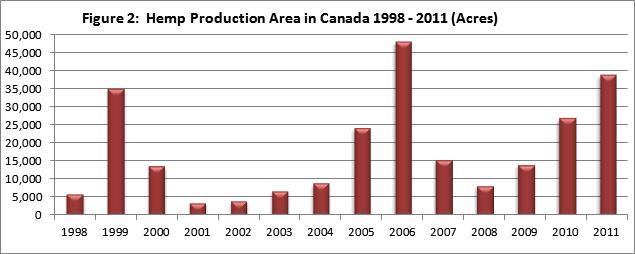
As with many new crops, there has been considerable fluctuation in hemp production area. Figure 2 shows the variation in seeded acres in Canada from 1998 to 2011. In 1998, the first year of Health Canada opening up the licensing process, about 241 licenses were issued. These licenses grew almost 5,927 acres (2,400 hectares) of hemp for industrial use. In 1999, the number of applications to grow hemp jumped dramatically to 545 with the area of hemp production increasing six-fold to nearly 35,086 acres (14,205 hectares). Much of this production was driven by the promise of the development of large scale industrial fibre plants in Manitoba, which encouraged farmers to plant substantial hemp area in anticipation of the processing needs of these plants. None of the plants materialized, leaving farmers with large inventories of hemp straw. This led to a decline in production area in 2000 and 2001 respectively.
Source: Health Canada
As shown in Figure 2, area under hemp production started to increase from 2002 and reached its highest level in 2006 at 48,060 acres (19,458 hectares). This increase was due to increased contracting, high yields, economics and non contracted production. In 2007, hemp production area decreased by about 68 percent due to increased inventory of hemp seed, positive economics of producing other crops as well the lack of processing facilities for hemp fiber and stock. In 2008, production area further decreased by almost 47 percent to 8,050 acres (3,259 hectares). Since 2009, seeded acres in Canada have increased consistently. Hemp grain production is forecast by the Canadian Hemp Trade Alliance to reach 100,000 acres by 2014 (Canada Hemp Trade Alliance website).
Provincial Seeded Acreage
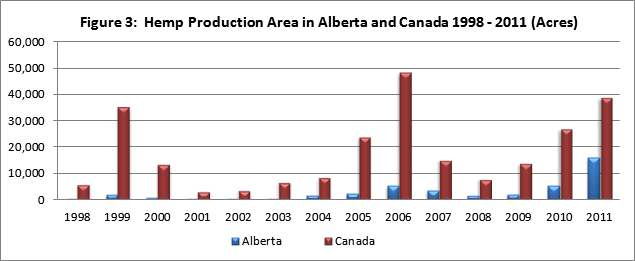
Figure 3 shows the area of hemp production for Alberta and Canada from 1998 to 2011.
Source: Health Canada
Overall production acreage in Alberta trended upwards with a total of 15,892 acres being registered in 2011. As shown in Table 1 below, Alberta’s share of total Canadian hemp production area ranged from approximately 2 percent in 1998 to approximately 41 percent in 2011.
Table 1 Hemp Seeded Acreage in Alberta and Canada, 1998 - 2011
Year | Alberta | Canada | |
 | Hectares | Acres | Hectares | Acres | % Alberta |
1998 | 38 | 94 | 2,400 | 5,927 | 1.58 |
1999 | 754 | 1,862 | 14,205 | 35,086 | 5.31 |
2000 | 306 | 756 | 5,485 | 13,549 | 5.58 |
2001 | 113 | 279 | 1,316 | 3,251 | 8.59 |
2002 | 123 | 304 | 1,530 | 3,779 | 8.04 |
2003 | 153 | 379 | 2,733 | 6,750 | 5.61 |
2004 | 639 | 1,578 | 3,531 | 8,722 | 18.10 |
2005 | 916 | 2,263 | 9,725 | 24,021 | 9.42 |
2006 | 2,103 | 5,194 | 19,458 | 48,060 | 10.81 |
2007 | 1,455 | 3,594 | 6,132 | 15,146 | 23.73 |
2008 | 582 | 1,438 | 3,259 | 8,050 | 17.86 |
2009 | 782 | 1,932 | 5,602 | 13,837 | 13.96 |
2010 | 2,086 | 5,152 | 10,856 | 26,814 | 19.22 |
2011 | 6,434 | 15,892 | 15,720 | 38,828 | 40.93 |
Source: Health Canada
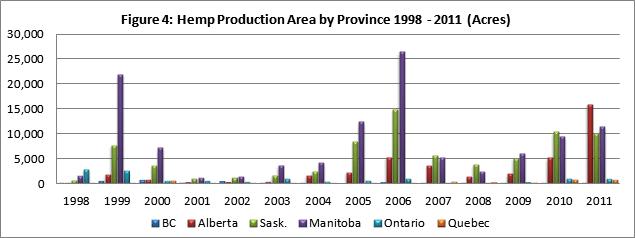
Figure 4 shows the area of hemp production for selected Canadian provinces from 1998 to 2011.
Source: Health Canada
Ontario topped the nation in hemp production area in 1998, followed by Manitoba from 1999 to 2009 then Saskatchewan in 2010 and Alberta in 2011. Overall, the Prairie Provinces (Alberta, Saskatchewan and Manitoba) led the nation in hemp production area. Tables 2 and 3 below provide data on hemp production area for various Provinces and Territories in Canada. No hemp was grown in New Brunswick, Nova Scotia, Prince Edward Island and Yukon Territories in 2010. In 2011, no hemp was grown in Nova Scotia and Yukon Territories (Tables 2 and 3).
Table 2: Hemp Seeded Acreage in Canada by Province, 1998 - 2011 (Hectares)
Year | BC | Alberta | Sask. | Man. | Ontario | Quebec | NB | NS | PEI | Yukon | Canada |
1998 | 72 | 38 | 263 | 606 | 1,163 | 24 | 214 | 19 | 0 | 0 | 2,400 |
1999 | 225 | 754 | 3,096 | 8,889 | 1,021 | 86 | 4 | 126 | 4 | 0 | 14,205 |
2000 | 291 | 306 | 1,426 | 2,902 | 217 | 239 | 1 | 102 | 2 | 0 | 5,485 |
2001 | 96 | 113 | 392 | 472 | 209 | 30 | 0 | 0 | 0 | 4 | 1,316 |
2002 | 200 | 123 | 449 | 597 | 142 | 19 | 0 | 0 | 0 | 0 | 1,530 |
2003 | 7 | 153 | 672 | 1,468 | 397 | 13 | 4 | 18 | 0 | 0 | 2,733 |
2004 | 18 | 639 | 1,004 | 1,655 | 183 | 10 | 4 | 18 | 0 | 0 | 3,531 |
2005 | 0 | 916 | 3,429 | 5,018 | 251 | 74 | 19 | 18 | 0 | 0 | 9,725 |
2006 | 111 | 2,103 | 6,025 | 10,705 | 398 | 91 | 8 | 18 | 0 | 0 | 19,458 |
2007 | 70 | 1,455 | 2,293 | 2,088 | 40 | 182 | 4 | 0 | 0 | 0 | 6,132 |
2008 | 5 | 582 | 1,537 | 993 | 8 | 134 | 0 | 0 | 0 | 0 | 3,259 |
2009 | 84 | 782 | 2,061 | 2,435 | 132 | 92 | 0 | 0 | 16 | 0 | 5,602 |
2010 | 64 | 2,086 | 4,214 | 3,799 | 372 | 321 | 0 | 0 | 0 | 0 | 10,856 |
2011 | 8 | 6,434 | 4,026 | 4,596 | 354 | 290 | 8 | 0 | 4 | 0 | 15,720 |
Source: Health Canada
Table 3: Hemp Seeded Acreage in Canada by Province, 1998 - 2011 (Acres)
Year | BC | Alberta | Sask. | Man. | Ontario | Quebec | NB | NS | PEI | Yukon | Canada |
1998 | 178 | 94 | 650 | 1,497 | 2,873 | 59 | 529 | 47 | 0 | 0 | 5,927 |
1999 | 556 | 1,862 | 7,647 | 21,956 | 2,522 | 212 | 10 | 311 | 10 | 0 | 35,086 |
2000 | 719 | 756 | 3,522 | 7,169 | 535 | 590 | 2 | 252 | 4 | 0 | 13,549 |
2001 | 237 | 279 | 968 | 1,166 | 516 | 74 | 0 | 0 | 0 | 10 | 3,251 |
2002 | 494 | 304 | 1,109 | 1,475 | 351 | 47 | 0 | 0 | 0 | 0 | 3,779 |
2003 | 18 | 379 | 1,661 | 3,625 | 981 | 32 | 10 | 44 | 0 | 0 | 6,750 |
2004 | 44 | 1,578 | 2,480 | 4,088 | 452 | 25 | 10 | 44 | 0 | 0 | 8,722 |
2005 | 0 | 2,263 | 8,470 | 12,394 | 620 | 183 | 47 | 44 | 0 | 0 | 24,021 |
2006 | 273 | 5,194 | 14,882 | 26,442 | 982 | 224 | 20 | 44 | 0 | 0 | 48,060 |
2007 | 173 | 3,594 | 5,664 | 5,157 | 99 | 450 | 10 | 0 | 0 | 0 | 15,146 |
2008 | 12 | 1,438 | 3,796 | 2,453 | 20 | 331 | 0 | 0 | 0 | 0 | 8,050 |
2009 | 207 | 1,932 | 5,091 | 6,014 | 326 | 227 | 0 | 0 | 40 | 0 | 13,837 |
2010 | 158 | 5,152 | 10,409 | 9,384 | 919 | 793 | 0 | 0 | 0 | 0 | 26,814 |
2011 | 20 | 15,892 | 9,944 | 11,352 | 874 | 716 | 20 | 0 | 10 | 0 | 38,828 |
Source: Health Canada
Production
Production is estimated using information on yield and acres harvested. Industrial hemp yield (grain or fibre) varies with variety, plant population, soil conditions, timing of harvest, and annual climatic conditions. The highest seed yield recorded to date in Canada has topped 2,000 lbs per acre; an average yield is between 600 to 800 lbs per acre, but rising (Canadian Hemp Trade Alliance). An acre will also produce an average of 5,300 lbs of straw, which can be transformed into about 1,300 lbs of fibre.
In Manitoba, hemp grain yields range from 100 to 1,200 lbs per acre while yield for crops grown and managed solely as fibre crops, range from 1 to 6 tonnes per acre (Manitoba Agriculture, Food and Rural Initiatives online report). The link to the report is as follows: http://www.gov.mb.ca/agriculture/crops/hemp/bko02s00.html). Typical grain yields in Saskatchewan vary from 660 to 1,071 lbs per acre (740 to 1,200 kg per hectare2). In Alberta, hemp grain yield from research plots have been found to vary from 196 lbs per acre (220 kg per hectare), to about 1,607 lbs per acre (1,800 kg per hectare)3. The expected yield would likely average nearly 759 lbs per acre (850 kg per hectare). Hemp straw yield under dryland conditions have an average of between 2.4 to 4.8 tonnes per acre (6 to 12 tonnes per hectare) for the higher yielding varieties like Crag (Alberta Agricultural Research Institute, 2008).
Detailed market information for hemp seed is not directly available. Based on discussion with some producers in Alberta, the cash sales price of hemp seed in 2011 was approximately 90 cents to $1.00. As shown in Table 3, Canada had 38,828 licensed acres in 2011. Over 80 percent of this was for seed production. Even though average yield vary, a reasonable yield estimate is approximately 1,100 lbs per acre (500 kg per acre). Based on this price and yield estimate, Canadian hemp seed production is estimated at approximately 15,513 tonnes assuming all acres cultivated to seed were harvested. This translates to estimated gross revenue of between $30.75 million to $34.17 million ($990 to $1,100 per acre).
Key Developments
Canadian industrial hemp production received a lot of attention in the early years. Advocates of hemp production painted a rather rosy picture for growth potential. However, the sudden demise of Consolidated Growers and Processors (CGP) Inc. of California left a large number of hemp growers in Manitoba sitting with a huge crop and nowhere to market it. This company was largely responsible for the rapid increase in acres in 1999 and the fallout in 2000.
The company created a lot of interest and hype for hemp among producers, particularly in Manitoba. The CGP contracted an estimated 40 percent of the total industrial hemp area licensed in Canada in 1999. However, the company went into receivership after failing to meet contractual obligations. This left the hemp producers with a huge surplus of hemp seed and fiber. This surplus was stored in warehouses and farmers’ bins, awaiting bankruptcy settlement. A considerable portion of the hemp crop did not get sold and producers had to absorb the losses. Thus, the negative events of 1999 brought a lot of skepticism and fear for the future growth potential of hemp industry in Canada.
Another interesting development in 2007 was the collaboration between National Research Council Canada (NRC) and Naturally Advanced Technologies (NAT) previously called Hemptown Clothing Inc. NAT has been working with the NRC Institute for Biological Sciences (NRC-IBS) to commercialize NRC developed enzyme technology for processing hemp fabric (enzymes are used widely in industrial applications for everything from pulp bleaching to meat tenderizers). The technology promises dramatically improved fiber quality (softer, whiter fabric) using environmentally friendly methods.
Since 2008 hemp cultivation in Canada has been increasing. This is buoyed by a steady increase in the processing of hemp, and the development of many small businesses engaged in developing new products and marketing these products. In Alberta, work is well underway at Alberta Research Council (ARC) and Alberta Agriculture and Rural Development to evaluate hemp as a potential source of pulp and fiber. For example, a pilot decortication plant has been established through the Alberta Biomaterials Development Centre (ABDC) BioIndustrial Initiative. The pilot plant uses European equipment. It has the largest biomass processing pilot plant fractionalization capacity in North America.
Currently, there are many Canadian companies - including Hemp Oil Canada Inc., Hempola Valley Farms, Fresh Hemp Foods Ltd., Ruths Hemp Foods, Cool Hemp, and Natures Path, etc. working to develop and market hemp seed products. These companies are all involved in the hemp seed market and are producing a wide range of products. These products are snack foods, hemp meal and flour, edible oil, shampoo and conditioners, moisturizers, commercial oil paints, beer and aromatherapy and cosmetic products. Most of the companies are reporting good growth.
Another trend worth noting is that the hemp food industry has switched to certified organic production because of strong demand. A few industry experts estimate that approximely one-third of Canadian hemp seed production is certified organic.
In April 2010, the Province of Manitoba through the Rural Economic Development Initiative provided $500,000 to Plains Hemp Processing in support of a new, innovative project design to process hemp. This hemp processing project is a first of its kind located in Gilbert Plains, Manitoba. Plains Industrial Hemp Processing currently manufactures several hemp based products such as hemp pellets, animal bedding and insulation. The newly built hemp processing plant will have the capacity to process up to 18,000 tonnes of hemp per year.
On December 13, 2010, the federal government announced an investment of $728,000 to help the hemp industry increase production capacity and make new inroads into the U.S. market. “Canadian farmers and processors are finding tremendous success with hemp thanks to its many nutritional benefits and wide range of uses in pasta, salad dressings and frozen desserts,” said Minister Toews. “This Government is proud to invest in this growing industry so that farmers can continue to expand their markets and develop more products.”The Government of Canada investment will support three groups:
- A $410,000 repayable contribution through the AgriProcessing Initiative for Fresh Hemp Foods to purchase and install new dehulling, oil pressing, and packaging equipment in its new 20,000 square foot state-of-the-art facility.
- A $300,000 repayable contribution through the AgriProcessing Initiative for Hemp Oil Canada to purchase and install new air classification milling and cold press oil expeller technology.
- An $18,625 investment through the AgriMarketing program for the Canadian Hemp Trade Alliance to enhance its website, hold a strategic planning meeting of its board of directors and take the first steps toward achieving Generally Regarded as Safe status in the U.S.
Canada exports industrial hemp in the form of hemp seeds, fibre, oil and oil-cake. In 2010, exports of hemp seed and hemp products were valued at more than $10 million, with most exports going to the U.S.
In November 2011, the Canadian government through the AgriMarketing Program announced an investment of more than $55,000 to the Canadian Hemp Trade Alliance (CHTA) to promote the high quality of Canadian hemp to international markets. This will include placing the Canada Brand and new CHTA logo on promotional materials as well as a trade show booth.
On April 1, 2012 Hemp Oil Canada Inc. based in Manitoba announced that it is first in the world to gain international food safety accreditation for hemp food http://www.mysteinbach.ca/newsblog/14830.html. This is good news for Hemp Oil Canada and the Canadian hemp industry as a whole because this may create more opportunities for food developers to market their hemp food products to international markets.
Prepared by:
Emmanuel Anum Laate
Senior Crop Economist
Economics Branch
Alberta Agriculture and Rural Development
Phone: 780-422-4054 |
|