| | Plant characteristics | Fall colour | Site preference | Hardiness | Uses | Problems | Diseases | Insects | Pruning
.
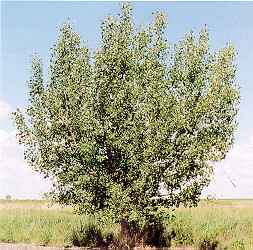
Scientific Name: Populus deltoides Marsh.
Plant Characteristics
This is the native poplar of the river flats in southeastern Alberta. It is a large, vigorous, deciduous tree with upright-spreading branches forming a rather open, broad crown. This tree can reach a mature height of 25 m (80 ft) with a spread of 15 m (50 ft). It is a fast-growing tree with a growth rate of approximately 30 to 150 cm (1 to 5 ft) per year, with a lifespan of 100+ years. The root system is usually quite shallow and wide-spreading, but in some locations the tree may develop deep roots.
Bark - Young branches are yellowish-grey. Older trees develop a dark grey, rough, furrowed bark.
Buds - Buds are brownish, sticky and pubescent.
Leaves - Leaves are alternate, simple, deltoid, 5 to 10 cm (2 to 4 in.) long. The margin of the leaf base is smooth, while the rounded sides are coarsely serrated. Leaves are light green, glossy above, slightly paler beneath, glabrous on either surface. Petioles are long, often flattened sidewise.
Propagated by cuttings.
Fall Colour
Leaves - golden yellow.
Site Preference
Wide soil adaptation. Plant in full sun or half shade. Requires generous amounts of water, although it can survive drought conditions.
Hardiness
Hardy - will survive under extreme climate exposure.
Uses
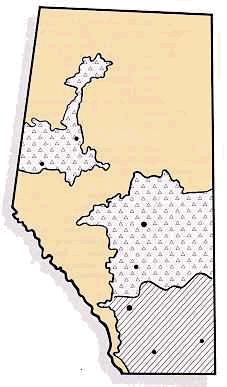
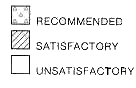
It is only recommended for wide boulevards, larger farmsteads and parks. For shelterbelt situations it should be planted 2 to 4 m (6 to 13 ft) between trees in the row and 5 to 8 m (17 to 26 ft) between rows.
Problems
The roots have to be able to reach the groundwater for survival.
Some suckering occurs if the roots are damaged.
Because of structural weaknesses the cottonwood cannot be recommended for planting in the vicinity of buildings. Older trees may be subject to breakage of large branches in severe windstorms.
Diseases
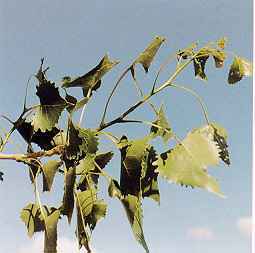
Appears to be more resistant to canker than the hybrid poplars. Susceptible to leaf rust.
Insects
Forest tent caterpillars.
Pruning
Usually allowed to develop multistems in shelterbelts. Prune only to remove dead, diseased or broken branches.
.
Shelterbelts Varieties for Alberta provides information on a number of other trees and shrubs than may be suitable for shelterbelts.
Visit our website directory for the Reforestation Woodlot Listings. |
|