| | Plant characteristics | Fall colour | Site preference | Hardiness | Uses | Problems | Diseases | Insects | Pruning ]
..
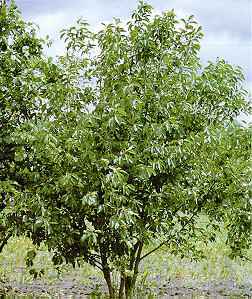
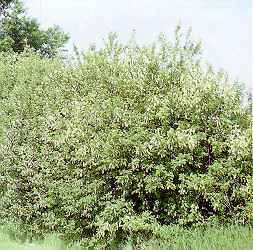
Scientific Name: Prunus virginiana L.
Plant Characteristics
Chokecherry is a large, deciduous shrub to small tree growing to a mature height of 4 to 8 m (13 to 26 ft), with a spread of 5 m (17 ft), and an annual growth of 10 to 50 cm (4 to 20 in.). The six - year - old and older wood should be removed to promote vigorous growth and fruiting of the shrub.
Flowers - Chokecherry flowers at the same time as it leafs out. The flowers are 8 to 10 mm (0.25 to 0.38 in.) across, white, in dense racemes, 7 to 15 cm (2.5 to 6 in.) long.
Fruit - Fruit very astringent, about 8 mm (0.25 in.) across, dark purple; stone smooth.
Leaves - Leaves broadly elliptic to obovate, sharply serrulate, glabrous or nearly so beneath; 4 to 12 cm (1.5 to 5 in.) long.
Propagated by seed.
Fall Colour
Leaves red-brown to yellow.
Site Preference
Chokecherry prefers a loam soil, can withstand some shade, and will survive while exposed to short periods of low moisture. It grows wild along riverbanks, thickets and open woods.
Hardiness
They will survive under extreme climate exposure.
.
Uses
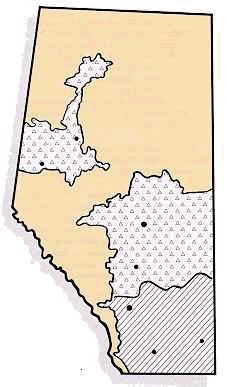
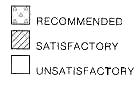
Chokecherries can be planted 1 to 3 m (3 to 10 ft) between plants in the row, and 5 to 8 m (17 to 26 ft) between rows.
Problems
Suckering habit can be controlled by cultivation.
Reported to cause occasional poisoning of sheep and cattle through the hydrocyanic content of the leaves, especially after frost.
Diseases
Susceptible to black knot (fungus). Control by pruning and burning removed portions.
Insects
Chokecherry midge, ugly nest caterpillar, fruit leafroller, prairie tent caterpillar.
Pruning
Removal of older stems will give better fruit.
Shelterbelts Varieties for Alberta provides information on a number of other trees and shrubs than may be suitable for shelterbelts.
Visit our website directory for the Reforestation Woodlot Listings. |
|