Overview of Alberta's Agricultural Carbon Offset Trading System 2007 to 2010


Subscribe to our free E-Newsletter, "RTW This Week"Sign up for our
E-Newsletter


 Summary

Alberta is the only jurisdiction in North America with legislated requirements for greenhouse gas (GHG) emission reductions. Alberta’s Climate Change Emissions Management Amendment Act (2007) has created a market of carbon trading between regulated emitters and farmers who can reduce or remove GHG emissions through practice changes. The basis for emission trading is Government of Alberta approved offset quantification protocols, developed using the International Standards Organization (ISO) 14064-2 process. These protocols link science-based emission reductions to improved management practices. A total of ten agricultural offset quantification protocols have been approved in the Alberta Offset System, representing one-third of the total number of protocols that are available for use.

Since 2007, the selling price of agricultural offsets to increased from $6 to $12 / tonne of carbon dioxide equivalent (T CO2e) to $10 to $14 / T CO2e within the emerging Alberta Carbon Market. This value is has been relatively stable and is typically higher than in voluntary carbon markets. This reflects the high quality of the offset developed in a regulatory context, as well as the price cap of $15 / T CO2e, set by other alternatives that can be used to meet compliance obligations. The use of offsets for compliance increased from 18 % in 2007 to 30% in 2010. Agricultural offsets represent 37% of total offsets created. They have been used to meet a total of 5.1 million tonnes (MT) CO2e reductions since 2007, representing 20% of actual emission reductions. This has generated close to $61 million of income for agriculture in Alberta.

Improvements to the Alberta Offset System are continuously being made as the carbon offset market grows and evolves. There is presently an option to sell carbon offsets back to 2002 with the Tillage System Management protocol as long as required records are in place to verify the practice change. Beginning on January 1, 2012, historical offsets cannot be created. However, credits that are already serialized (posted on the Alberta Offset Registry and available for purchase) will be honored. Farm records will continue to be a critical component to confirm practice improvements .

Other jurisdictions are watching and learning. Saskatchewan has similar legislation pending and is working closely with Alberta to develop its own offset system. British Columba, Manitoba, Ontario and Quebec are part of the Western Climate Initiative (WCI). Australians have made a number of inquiries about the Alberta Offset System and New Zealand is currently developing its own offset system. The Alberta Offset System is being promoted by lobby groups to various governments.

Background

Carbon offsets are created when GHG emission reductions by one organization are purchased by another. The end result is fewer GHG in the atmosphere than would otherwise occur. Offsets are typically measured in tonnes of CO2e, which includes carbon dioxide (CO2), methane (CH4) and nitrous oxides (N20), weighted according to their relative global warming potential.

Alberta emits about one-third of Canada’s total GHG emissions. In 2002-3, Alberta initiated a Climate Change Action Plan. This included a Specified Gas Emitters Regulation (SGER) which applied to all facilities producing over 100,000 T CO2e per year (Fig. 1). These companies are required to report annual emission intensities. In 2007, Alberta amended the SGER to require mandatory annual emission intensity reductions of 12% below their baseline levels (2003-5). This requirement applies to close to 100 Alberta facilities.


Figure 1. Profile of Alberta companies that emit more that 100,000 T CO2e per year. Source: Climate Change Central

Regulated emitters have four options to meet legislated reduction requirements:
i) Make internal improvements,
ii) Generate Emission Performance Credits (EPCs) beyond requirements for trade or future use,
iii) Pay into the Climate Change Emissions Management Corporation (CCEM) Fund at $15 / T CO2e, or,
iv) Purchase Offsets created using Government of Alberta approved protocols


In 2008, 87% of Alberta’s GHG emissions came from the energy sector, and 7% from agriculture. Offsets can be created using agricultural practice changes that reduce these emissions, such as improved manure management techniques. These can also be supplemented by practices changes that remove GHG emissions from the atmosphere, such as by increasing amounts of carbon captured by plants and stored in the soil.

Offset Creation

Government of Alberta approved protocols outline management improvements that can generate carbon offsets in the Alberta Offset System. Key requirements are that offsets are: real (above and beyond business as usual), quantifiable (based on sound science) and verifiable (by an independent third party). Other requirements are described at: http://carbonoffsetsolutions.climatechangecentral.com/offset-protocols/alberta-protocol-development-process. Required compliance with the ISO 14064-2 process ensures consistent, science-based links to management or technology changes that reduce or remove GHG emissions relative to a business as usual or baseline activity.

The end result is that offsets created in Alberta are:
• Internationally compatible, standardized
• Based on best possible science with rigorous technical review
• Use emission factors and calculations and only require tracking of practice changes
• Describe monitoring and verification requirements
• Reduce costs for project developers
• Are assured by government approval of protocols, third party verification and registration on the Carbon Offset Registry
• Provide certainty about GHG tonnes reduced for investors

Project developers can then identify practice changes that create offsets by removing or reducing emissions and the steps needed to register the offset for use to meet compliance (Fig. 2).

Agricultural Carbon Trading

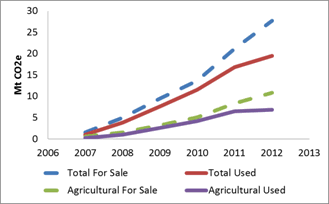
Since 2007, Alberta’s greenhouse gas reduction program has reduced actual emissions by 26 million tonnes (not including CCEM fund), which is like removing 5.2 million cars from the road. Overall, offsets have delivered 53% of those reductions. Although total numbers of registered offsets decreased by 5% between 2009 and 2010, agricultural offsets increased by 13% (Table 1). The reason for a leveling off interest in non-agricultural offsets is primarily due to a lack of increase in the number of new offset project types (e.g. wind energy).


Figure 2: Overview of how an offset credit gets to market in Alberta. Source: Climate Change Central

Agricultural offsets represented 37% of the total registered tonnes of CO2e since 2007 and contributed 20 % of actual total GHG emission reductions, or, 1 million fewer cars on the road.. Other non-agricultural offsets that have been used to meet emission reduction requirements include wind energy, landfill gas capture and waste heat recovery.

Table 1. Overview of agricultural offset system activity in the context of other offset types.

Alberta Offset System
Activity
2007
2008
2009
2010
Total
No. of Projects
Tillage Management
Other Typles of Projects
7
3
4
25
10
15
26
15
11
20
16
4
78
44
34
Total Registered (T CO2e)
Total Retired (submitted for compliance)
1,555,037
986,700
3,471,495
2,845,763
4,432,124
3,828,232
4,215,550
3,858,619
13,676,206
11,544,304
Agricultural Tonnes registered (T CO2e)
Agriculture Tonnes Retired
558,714
202,210
1,000,976
821,836
1,654,084
1,584,108
1,870,710
1,568,079
5,084,484
4,201,204

All of the agriculture projects registered to date have used the Tillage System Management protocol. If records are available to verify that the reduced tillage practice occurred, the value is up to $2 per ac per year. These values reflect discounts for early adoption, assurance of permanence and vary with soil zone, tillage type and service fees. In 2007, Tillage Management offsets sold for $6 to $12 T / CO2e with transaction costs of 30 to 40%. In 2010, Tillage Management offsets sold for $10 to $14 T / CO2e with transaction costs of about 30%. The total value of all 5.1 MT CO2e generated by Tillage Management offsets is close to $61 million.

Another option for regulated companies to reduce emissions is to pay into the Climate Change Emissions Management Corporation (CCEM) Fund that is to be used for research and development of new methods of reducing emissions. To date the fund contributions are $256 million. Internal improvements to infrastructure can also be made, with the possibility for use of excess reductions (Emissions Performance Credits) in the future or for trading. Fig. 3 shows changes in rates of other types of compliance between 2007 and 2010.


Figure 3. Methods used to meet compliance obligations under the Specified Gas Emitter Regulation by Alberta companies in 2007 and 2010, including payment into the Climate Change Emission Management Fund (CCEM) and generation of Emission Performance Credits (EPCs). Source: Climate Change Central, May 2011

Updates to the Alberta Offset System

On January 1, 2012, the Alberta Offset System will be increasing verification requirements from Limited to a Reasonable Level of Assurance for auditing purposes. Although this means more farm records as proof of practice change, many of the farm record and data management systems that are in place to access current protocols will provide a sound basis for addressing these requirements. In addition, new opportunities to generate agricultural offsets have been developing, such the approval of new protocols on improved management of nitrogen fertilizer and dairy cattle, as well as the completion of Interpretive Guides to support the use of approved protocols.

Economic and sector growth opportunities exist for agriculture to take part in further reduction programs for GHG emissions, not only in Alberta but in other voluntary markets. The US has stated it will consider GHG regulations and accounting as a trade issue with trading partners. We’ve also had some interest from a European country about purchasing offsets from agricultural practice improvements.

Aside from new income opportunities for improved practice changes, co-benefits of agricultural practice improvements to create offsets include improved efficiencies of production and heightened values of farm data / digital records. The new knowledge gained about requirements for verification and assurance is also transferrable to other emerging environmental market opportunities, such as the identification and verification of water and pesticide footprints.

Approved Agricultural Offset Protocols

Of the 29 offset protocols currently approved under the Alberta Offset System, 10 are agricultural:

Tillage System Management with Summerfallow Reduction*Beef - LifecycleBiogas
PorkBeef - Reduced Days on FeedBiomass
DairyBeef - Edible Oils*Energy Efficiency
Nitrous Oxide Emission Reduction (NERP)
*Co- implemented with Tillage System Management protocol

Although only the Tillage Management protocol has been used to date, Interpretation Guides to support use of other approved agricultural protocols are currently under development. Summaries of agricultural protocols are available at http://www1.agric.gov.ab.ca/$department/deptdocs.nsf/all/cl11618.

Potential New Agricultural Protocols

Alberta Agriculture and Rural Development staff continue to work with researchers, Alberta Environment and private industry to develop new agriculture offsets protocols and increase their uptake through extension meetings and web-based information delivery.

Protocols submitted to Alberta Environment for approval:
Afforestation (modification of approved), Beef – Residual Feed Intake

Protocols under development:
Wetlands Restoration and Preservation, Conversion to Perennial Cropping, Covered Manure Storage, Pasture Management

Possible future protocols:
Fuel Use Efficiency, Crop Nitrogen Use Efficiency, Biofibres

Approved and developing agricultural offset protocols are available at: http://carbonoffsetsolutions.climatechangecentral.com/offset-protocols/approved-alberta-protocols


For more information, contact Alberta Agriculture and Rural Development staff:

Sheilah Nolan
Climate Change Specialist
780-427-3719
sheilah.nolan@gov.ab.ca
Tom Goddard
Senior Policy Advisor
780-427-3067
tom.goddard@gov.ab.ca


For more information about the content of this document, contact Sheilah Nolan.
This document is maintained by Deb Sutton.
This information published to the web on July 8, 2010.
Last Reviewed/Revised on October 5, 2011.